> For the complete documentation index, see [llms.txt](https://docs.daylite.app/help/llms.txt). Markdown versions of documentation pages are available by appending `.md` to page URLs; this page is available as [Markdown](https://docs.daylite.app/help/mac-fundamentals/contact-management/managing-your-contacts.md).
# Contacts Overview
See how contacts work in Daylite — what People and Companies are, why they are separate records, where they appear, and how you classify and share them.
Contacts in Daylite are the records that hold the individuals and organizations you do business with. They come in two types — People and Companies — and they sit at the centre of the database: emails, Tasks, Appointments, Opportunities, and Projects all link back to a Person or a Company, which is how Daylite assembles a complete history for every relationship.
**Key facts:**
* Daylite stores contacts as two separate record types: People and Companies.
* A Person can be linked to more than one Company, and each link carries its own Role and Job Title.
* Each contact holds one Category at a time, and any number of Keywords.
* Every contact has an Activity View showing every linked interaction in chronological order.
* Contacts are available on Mac, iPhone, and iPad, and sync between them through Daylite Cloud.
## What Are Contacts in Daylite?
A contact in Daylite is a record representing someone you do business with. Daylite stores two kinds: a Person is a record representing an individual contact, such as a client, lead, colleague, or supplier; a Company is a record representing an organisation, business, association, or group.
Contacts are the anchor the rest of Daylite attaches to. When you add an email to Daylite, create a Task, book an Appointment, or open an Opportunity or Project, you link it to the Person or Company it concerns. Each of those links appears on the contact's record afterwards, so the full history of a relationship lives in one place rather than being scattered across your inbox, your calendar, and your notes.
Daylite does more than sync names, phone numbers, and addresses to Apple Contacts. It stores additional information about each contact and associates it with the related records around them.
## Why People and Companies Are Separate Records
People and Companies are separate record types so that each can be tracked on its own terms and then linked together. An individual and the organization they work for have different details, different histories, and different connections, and keeping them in one record would force you to choose which of the two you were really recording.
Each record holds what belongs to it. A Person holds their own phone numbers, email addresses, Job Title, Category, and Keywords. A Company holds the legal name, logo, main phone numbers, office addresses, web page, and the industry fields — Industry, Company Type, and Region. Because several People link to one Company, the organization's details are entered once rather than repeated on every employee.
Separation is what keeps those details, the history, and the connections accurate when a relationship changes — when someone works with several organizations at once, changes jobs, or plays a different part in different pieces of work. The history you have with the Company stays on the Company record, and the individual's own history stays on their Person record.
### History at Both Levels
People and Companies each have their own Activity View, so you can see the history with one individual and the history with the organization as a whole. If you have had a call with a specific person, you can open their record and go straight to that history rather than reading through everything that has happened with the Company.
This also makes handoffs easier. A team member opening a Company record sees the work the whole team has done with that client, not only their own conversations.
### You Do Not Enter the Same Details Twice
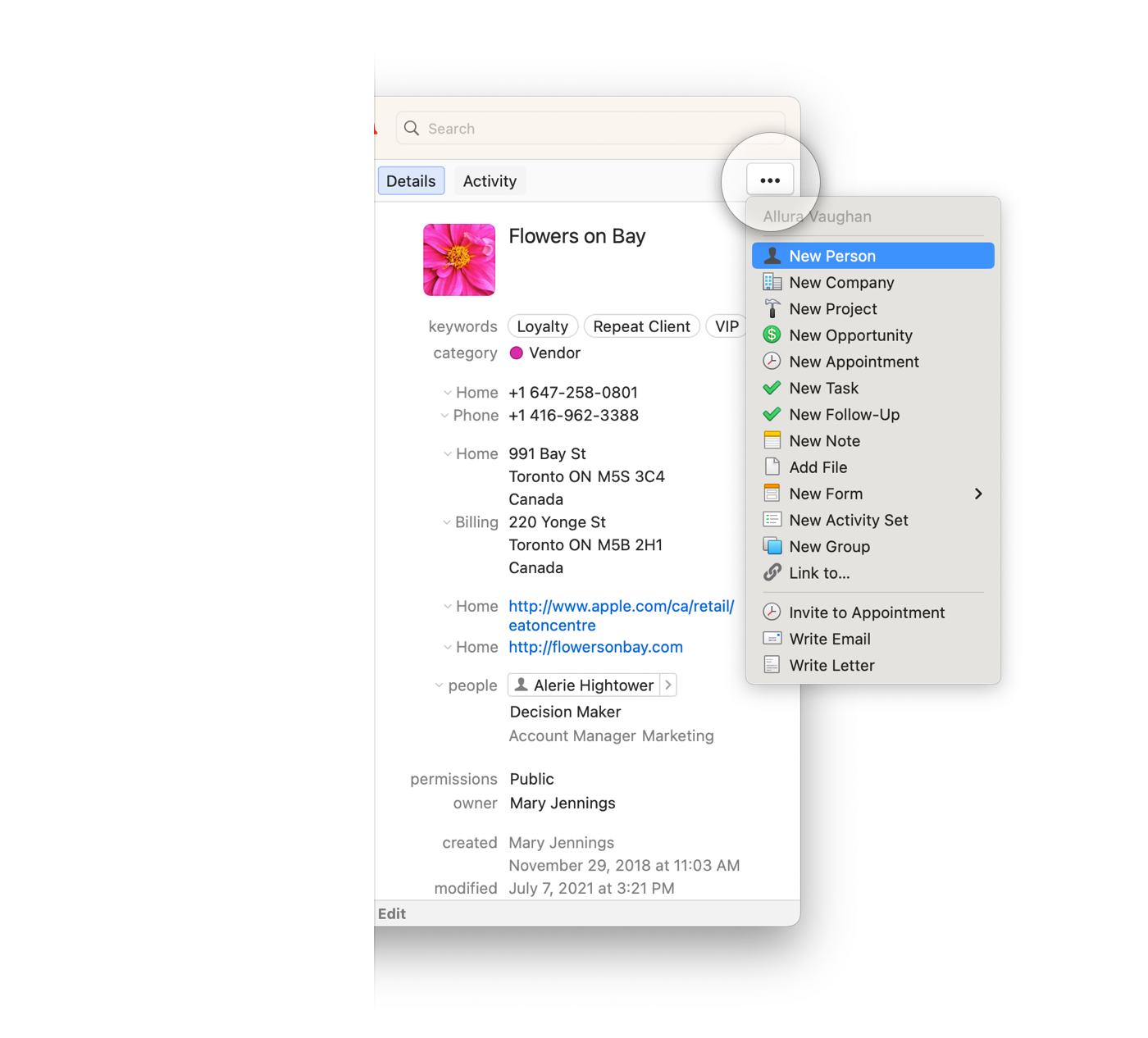
The records are separate, but the work is not duplicated. When you add a Person from a Company record using the **…** menu, Daylite copies the Company's address and phone numbers onto the new Person.
### A Company Does Not Have to Be a Business
A Company record can represent any group, including a household — "The Johnson Family", for example — with each family member as their own Person record linked to it. This is how photographers, realtors, financial planners, and family law practices usually set Daylite up.
For the procedures, see [People in Daylite](https://docs.daylite.app/help/fundamentals/contacts/people-in-daylite) and [Companies in Daylite](https://docs.daylite.app/help/fundamentals/contacts/companies-in-daylite).
## How People Link to Companies through Roles
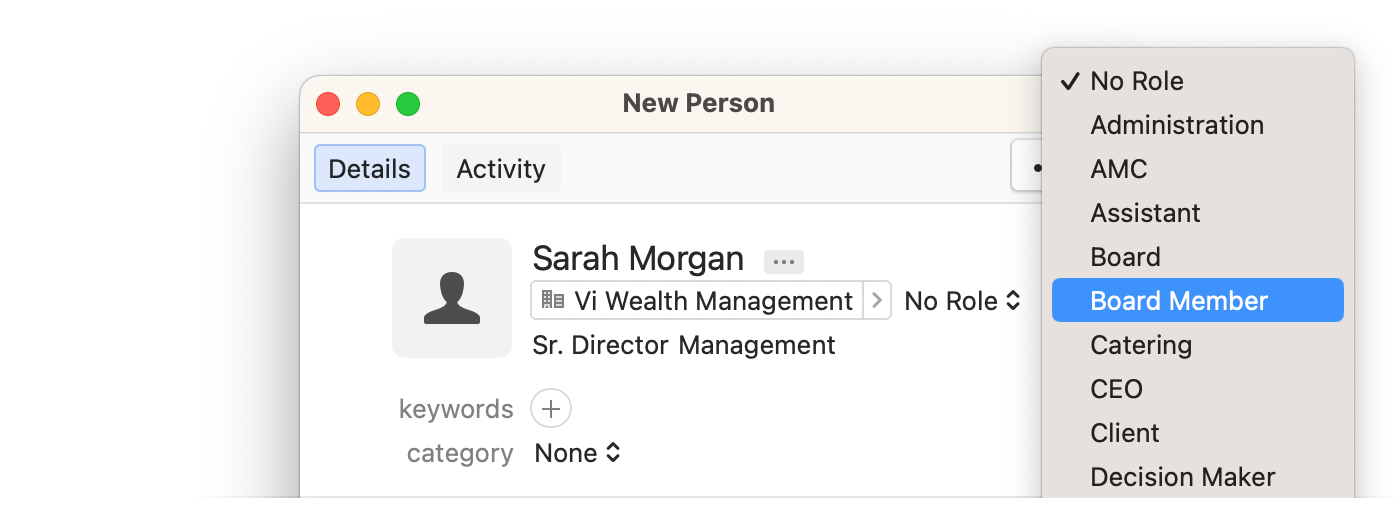
A Role is a label that describes the function a Person or Company plays in a specific Company, Opportunity, or Project link — for example Owner, Manager, or Decision Maker. A Role belongs to the link itself rather than to the record, and it is not the same thing as a job title.
Because the Role sits on the link, the same Person can hold a different Role in each context they appear in. Jane can be the Decision Maker at Company Y and the Lead Designer on Project X at the same time, from one Person record.
When you link a Person to a Company, you can define the nature of that link by adding a Role, a Job Title, and a Department.
Daylite also supports Relationships, which are labels describing the connection between two People or two Companies. Between People, a Relationship records who knows who and how — "Chuck referred Scott", or "Stephen is the assistant of David". Between Companies, it records how two organizations are connected or affiliated — "Sunshine Consulting is the parent company of The Dreamers". Relationships are bidirectional and are set in **Settings > Roles & Relationships**.
## Where Your Contacts Appear in Daylite
### The Sidebar
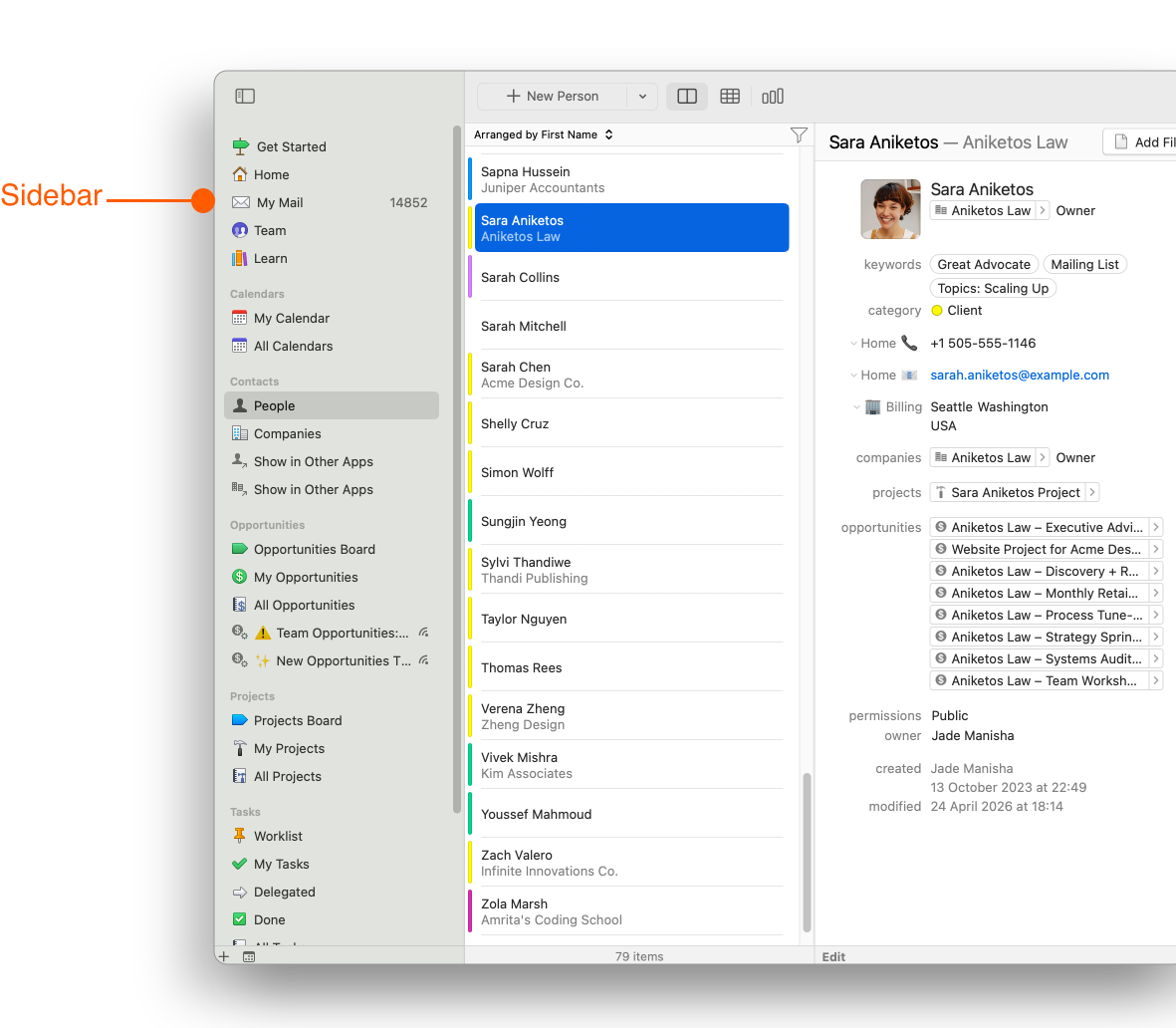
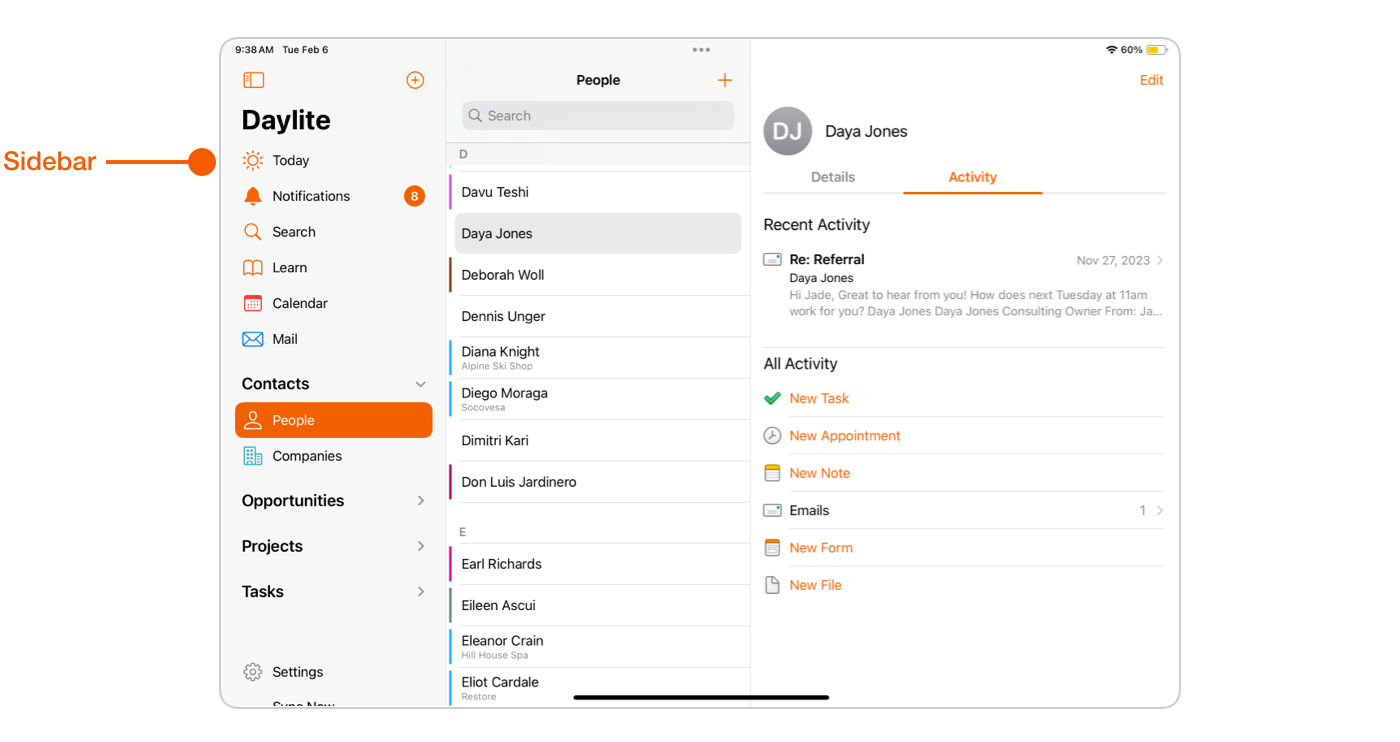
The Sidebar is how you navigate to what you want to work with. Under **Contacts**, you will find **People** and **Companies**. Selecting either shows the full list of those records, with the total count at the bottom of the list.
{% tabs %}
{% tab title="Mac" %}
{% endtab %}
{% tab title="iPhone & iPad" %}
{% endtab %}
{% endtabs %}
### List View, Multi-Column View, and Insight View
{% tabs %}
{% tab title="Mac" %}
Three views are available when you are looking at your contacts on Mac.
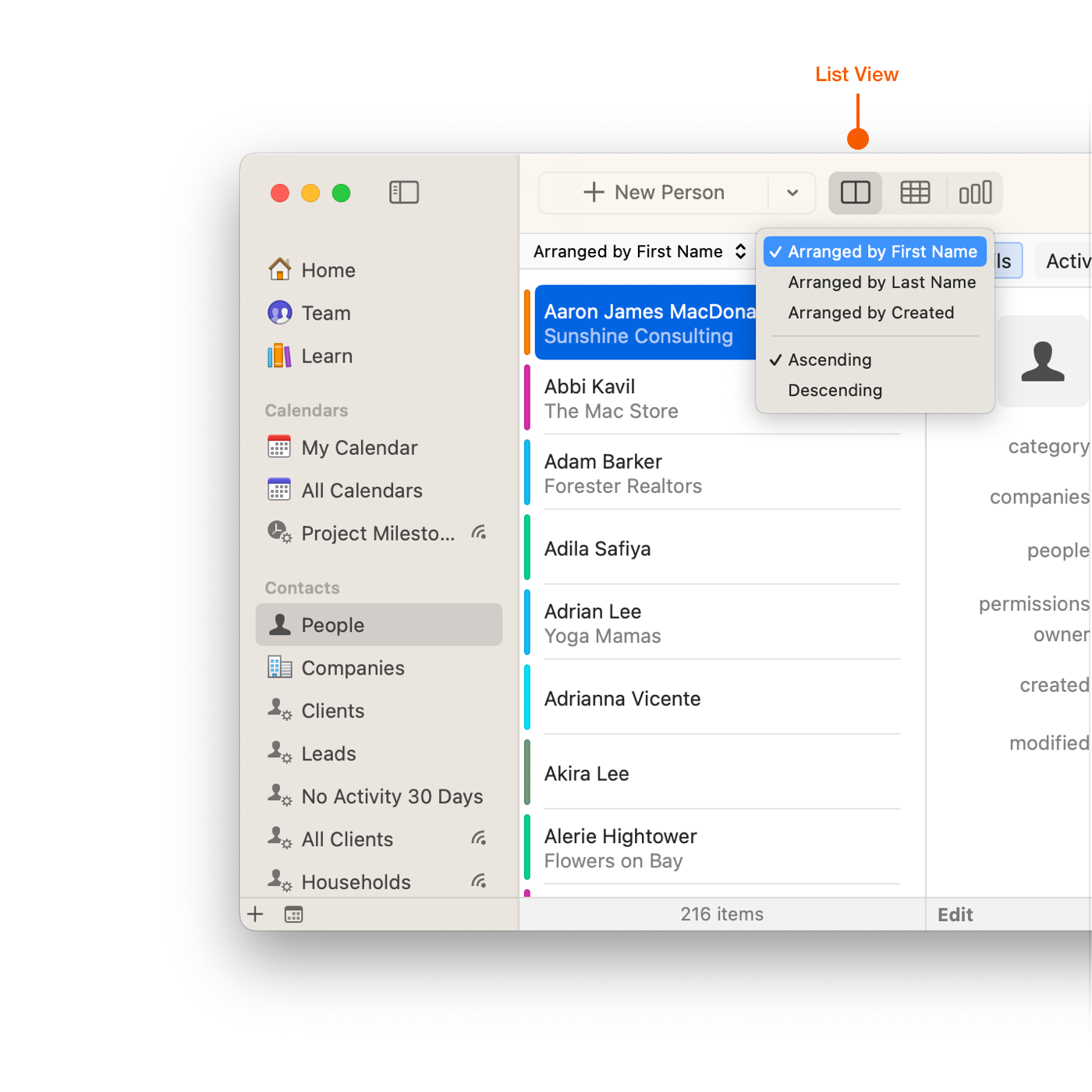
**List View** shows your contacts in a single list with the selected record's details on the right. You choose how the list is ordered using the **Sort Order** control above it. Sort Orders include:
* Arranged by First Name
* Arranged by Last Name
* Arranged by Created
* Ascending
* Descending
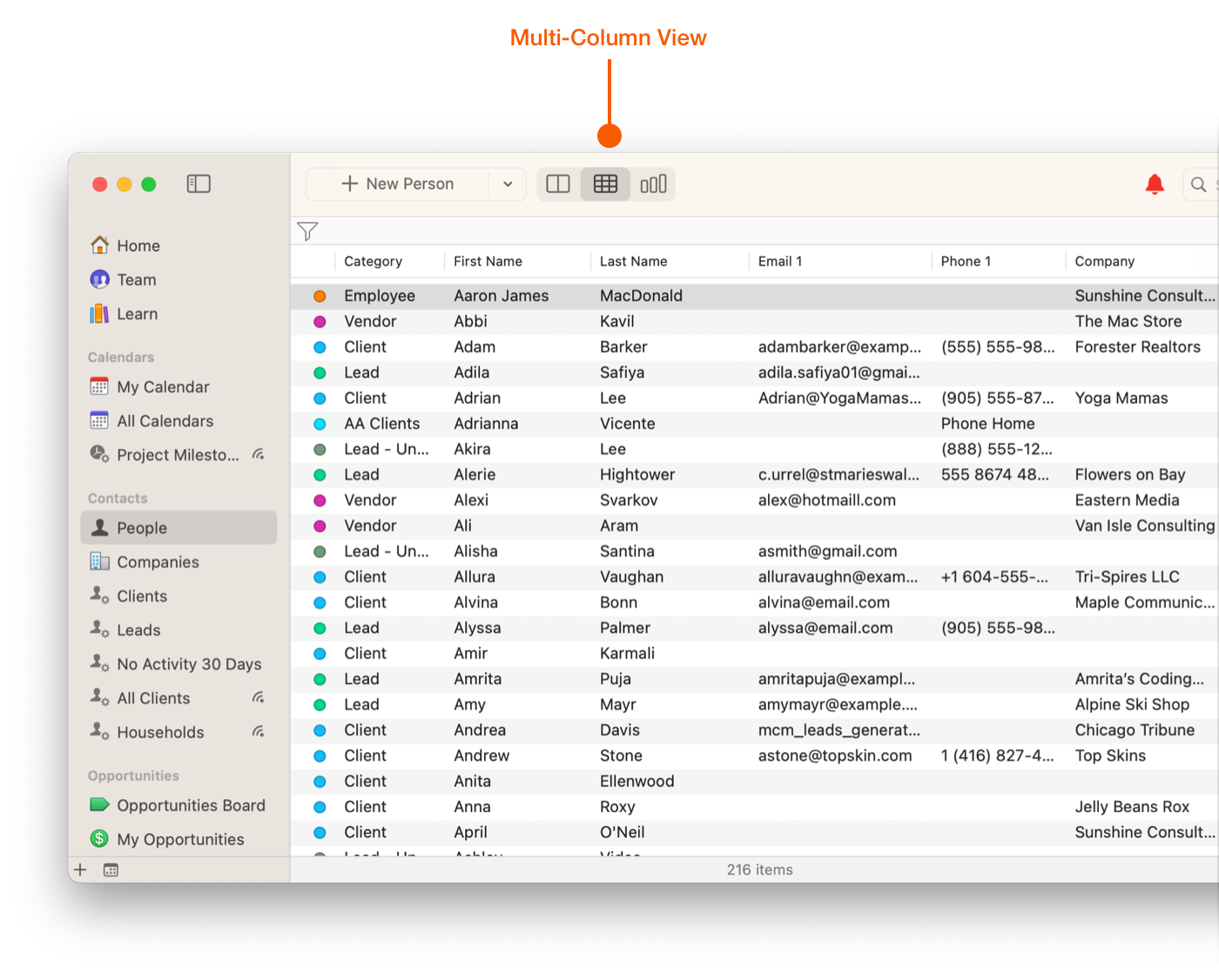
**Multi-Column View** displays specific information in column format, and lets you re-order and sort by columns.
{% hint style="info" icon="lightbulb" %}
**Did you know?**
You can use the Multi-Column List View to set up printed reports in Daylite. Choose the columns to display, select the column to sort by, and then print the information out or save to PDF.
{% endhint %}
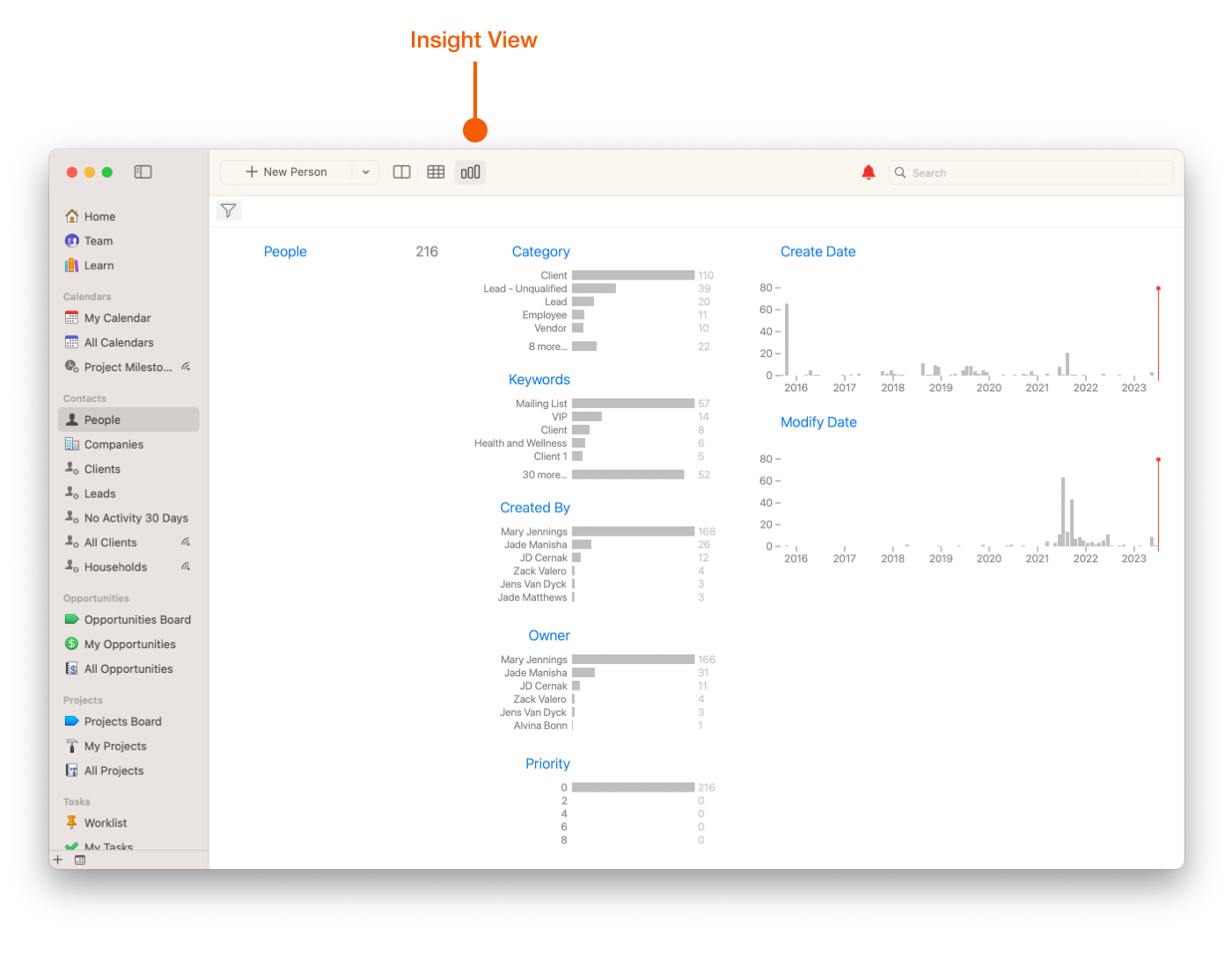
**Insight View** gives you an overview of your contact information in bar graph form, and lets you drill down or search by clicking any of the bar graphs to narrow your search parameters.
{% endtab %}
{% tab title="iPhone & iPad" %}
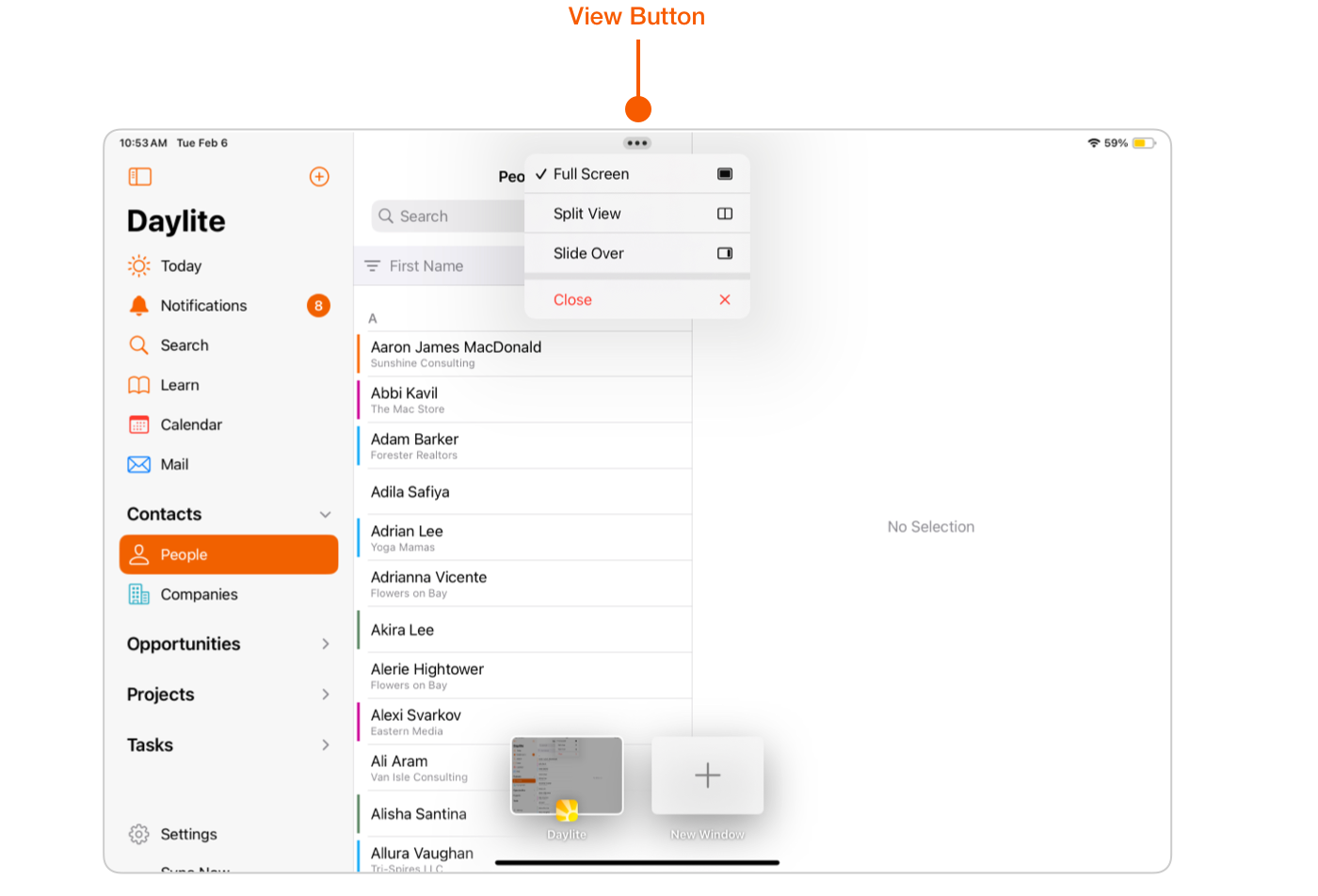
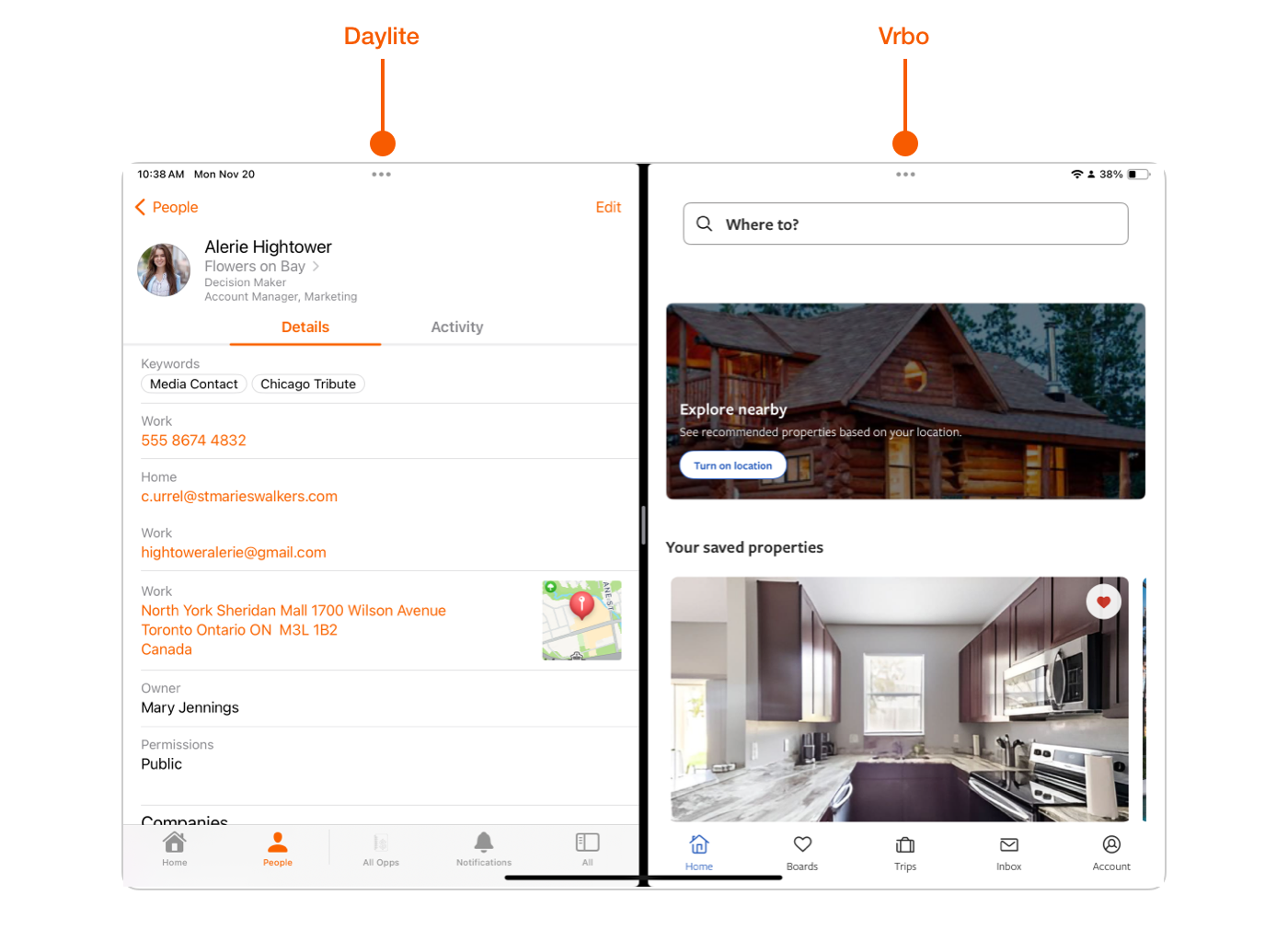
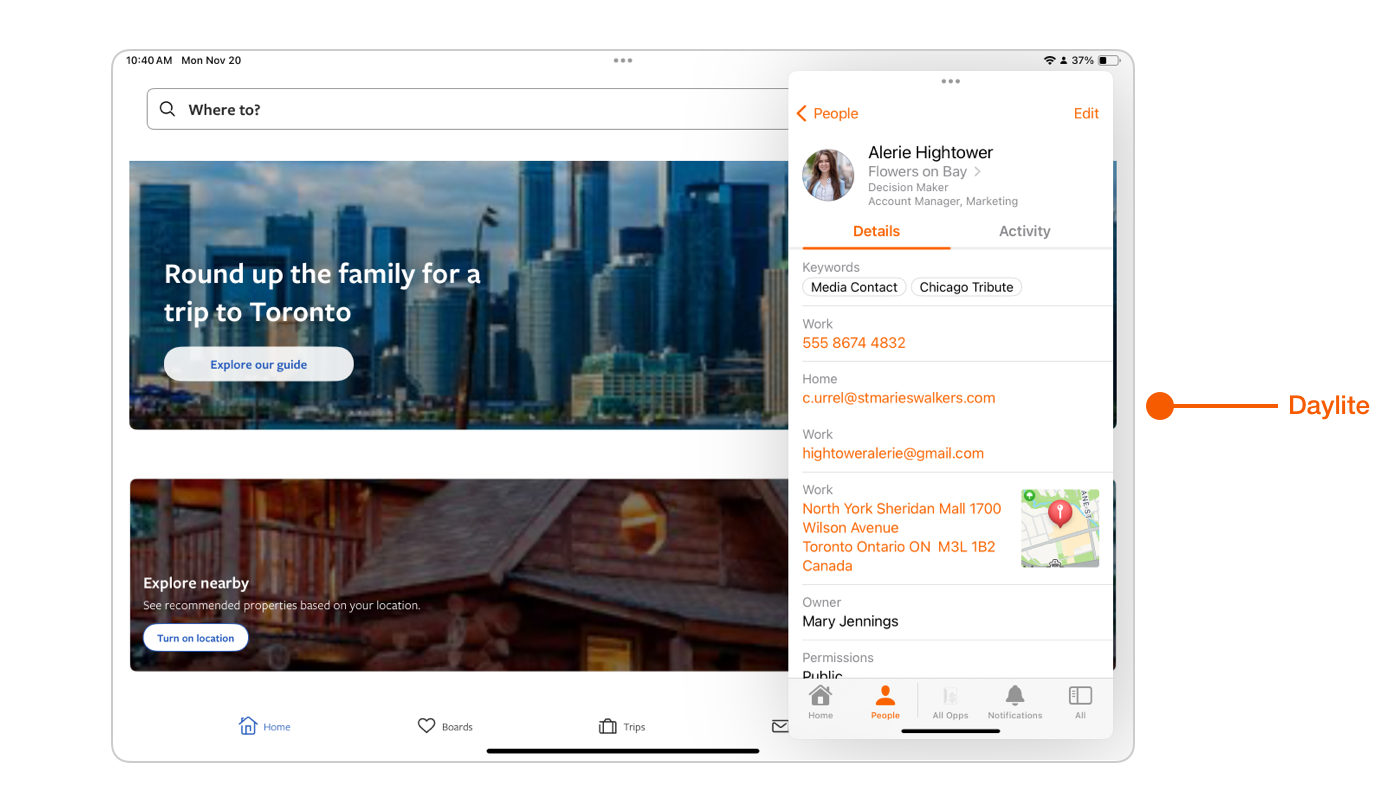
On iPhone and iPad, Daylite offers three display modes rather than the three Mac views.
**Full Screen** displays Daylite on its own, in either landscape or portrait.
**Split Screen** places Daylite and one other app side by side.
**Slide Over** overlays Daylite on the right-hand side of the screen, with the second app in full screen behind it.
{% hint style="info" icon="lightbulb" %}
Split Screen and Slide Over are available on iPad. Availability on iPhone depends on your device model and iOS version.
{% endhint %}
{% endtab %}
{% endtabs %}
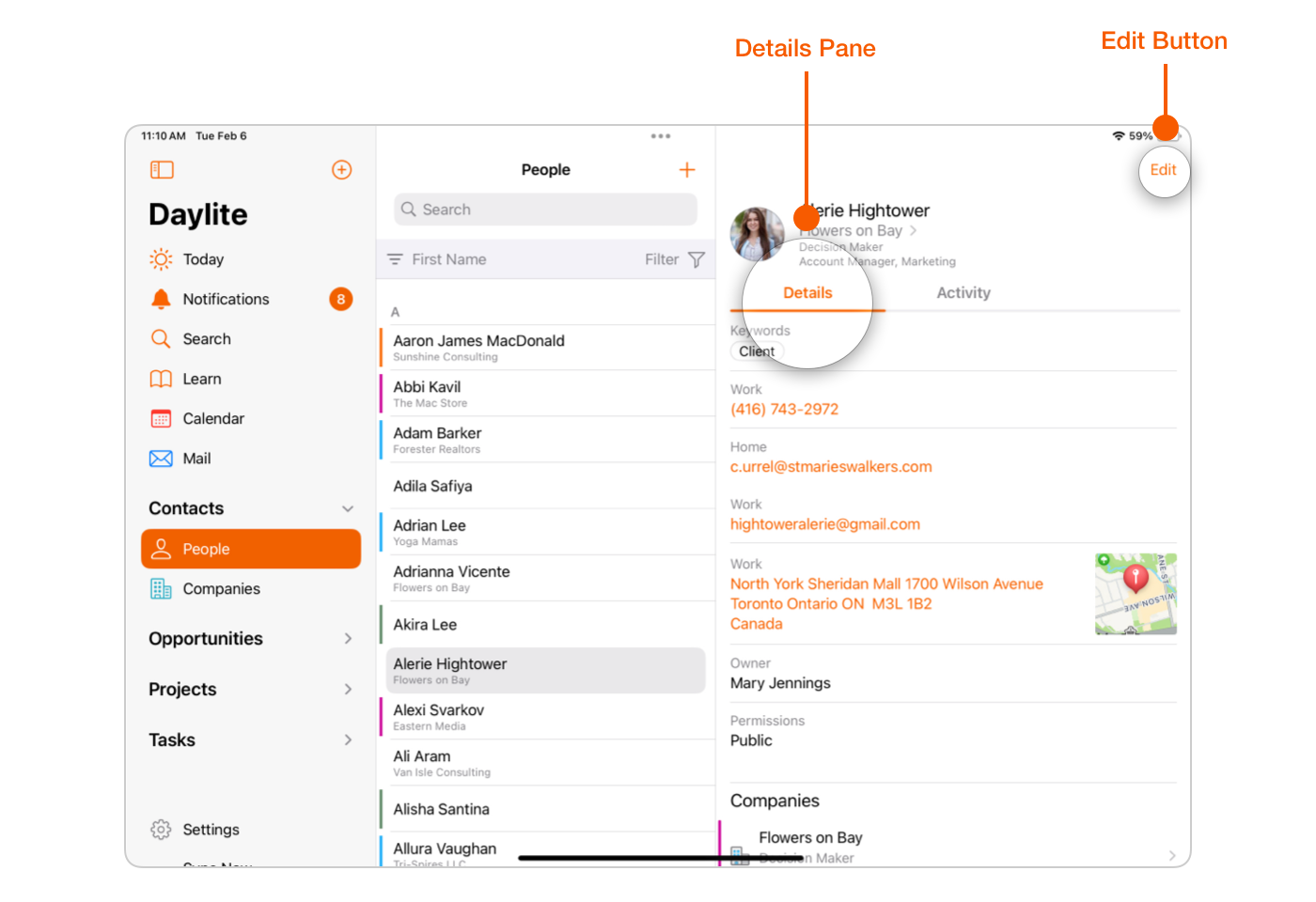
### The Details Section
The Details section shows the information held on the selected contact, including its Category and Keywords. These are what you search and filter on when you want to find a contact by phone number, address, the Project or Opportunity it is linked to, or who owns the record.
{% tabs %}
{% tab title="Mac" %}
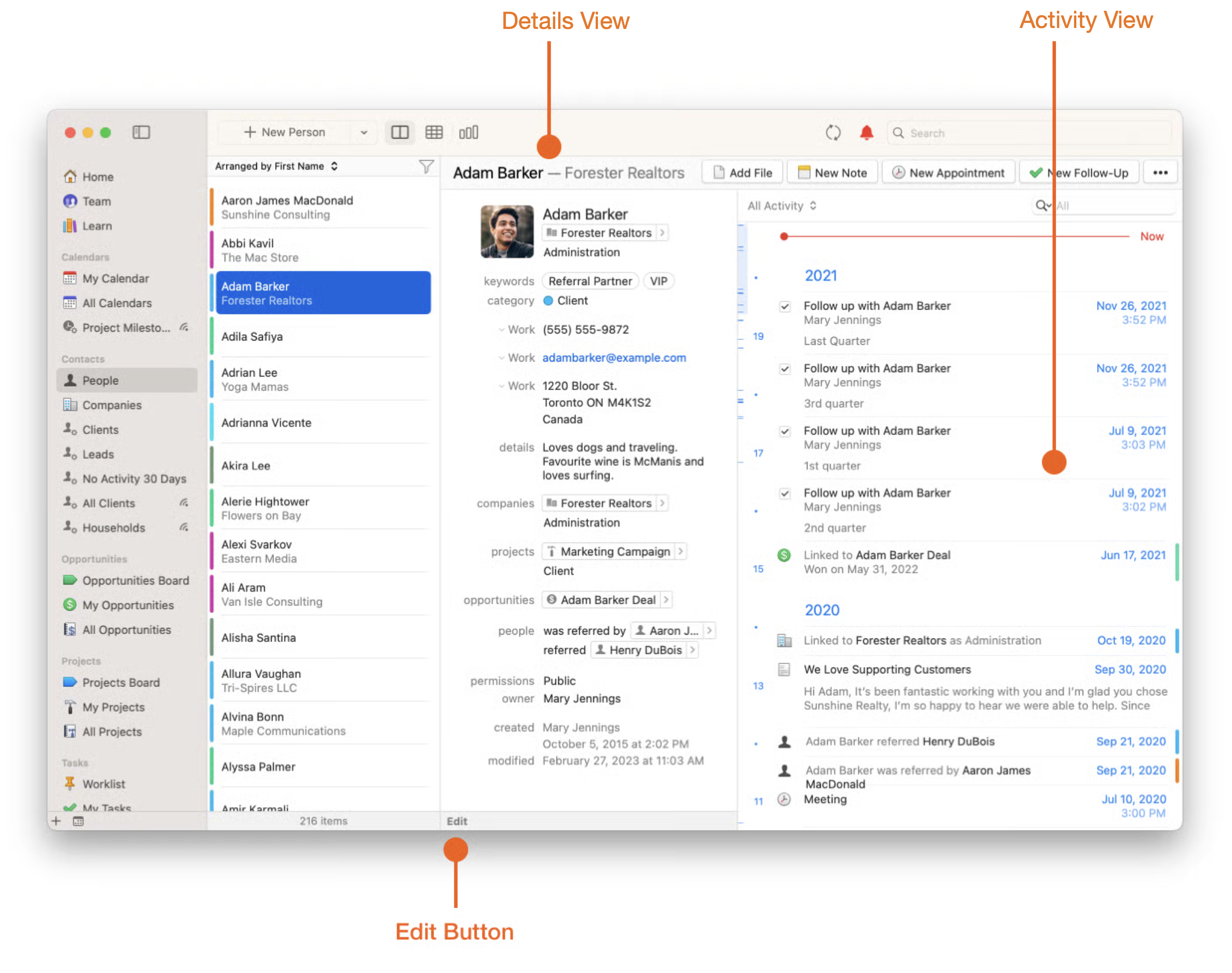
The Details section is also available in List View. Click **Edit** at the bottom of the Details section to change what it holds.
{% endtab %}
{% tab title="iPhone & iPad" %}
Tap **Edit** at the top of the Details pane to change what it holds.
{% endtab %}
{% endtabs %}
### The Activity View
The Activity View is a timeline on a contact, Company, Opportunity, or Project showing every linked email, meeting, note, Task, Opportunity, and Project in one place. On a contact it shows every interaction you have had with that contact to date — email correspondence, follow-ups, reminders to send proposals, meeting notes, and calendar Appointments — listed chronologically by time, day, and year.
## How to Classify Contacts with Categories and Keywords
Categories and Keywords are the two labels Daylite uses to classify contacts, and they behave differently.
A Category is the primary classification label on a record. A contact holds one Category at a time, each Category can be given a colour, and each record type has its own independent Category list. Examples include Prospect, Client, Lead, Personal, and Vendor.
A Keyword is a descriptive tag you apply to a record to classify it beyond its primary Category. You can apply as many Keywords to a contact as you like, there is no limit to how many you can create, and Keywords cannot be given colours. Examples for a Person include "Newsletter recipient" or "Lead Source: Website".
| | Category | Keyword |
| ---------------------- | ------------------------- | ----------------------- |
| How many per record | One | Any number |
| Colour coded | Yes | No |
| Where it is customized | **Settings > Categories** | **Settings > Keywords** |
{% hint style="info" icon="lightbulb" %}
Do not use the same naming convention for a Category and a Keyword. Prefacing similarly themed Keywords — "*Lead Source: Website*", "*Lead Source: Word of Mouth*" — keeps related Keywords clustered together in the list.
{% endhint %}
Categories and Keywords are also the fields you filter contacts on. For how filters are built and saved, see [Filtering on Mac](https://docs.daylite.app/help/mac-fundamentals/find-connect-and-organize/filtering-on-mac) and [Filtering on iPhone & iPad](https://docs.daylite.app/help/mac-fundamentals/find-connect-and-organize/filtering-on-iphone-and-ipad). A Smart List is a saved, dynamic search that updates itself as your data changes; Smart Lists are available on Mac only. See [Smart Lists](https://docs.daylite.app/help/mac-fundamentals/find-connect-and-organize/smart-lists).
## Sharing Your Contacts with Other Apps
Daylite can share your contact list with Apple Contacts and other CardDAV-compatible apps, so your contacts are available outside Daylite — for Caller ID on iPhone, calls placed with Siri, business card scanners, and Mail's VIP list.
Sharing does not merge databases. Each contact list is kept separate, with your Daylite contacts appearing as their own group.
For the full procedure, including generating app-specific credentials, see [Sharing Contacts from Daylite](https://docs.daylite.app/help/fundamentals/contacts/sharing-contacts-from-daylite).
## Frequently Asked Questions
**What is the difference between a Person and a Company in Daylite?** A Person is a record for an individual, such as a client, lead, colleague, or supplier. A Company is a record for an organisation, business, association, or group. They are separate record types, and a Person is linked to a Company rather than stored inside it.
**Can a Person be linked to more than one Company?** Yes. You can link a Person to multiple Companies, and each link can carry its own Role, Job Title, and Department.
**How many Categories can a contact have?** One. A contact holds a single Category at a time. If you need more than one label on a contact, use Keywords, which have no limit.
**Can a Company record be a family or a household?** Yes. A Company record can represent any group, not only a business — a household such as "The Johnson Family", for example, with each family member linked to it as their own Person. Photographers, realtors, financial planners, and family law practices commonly use Daylite this way.
**What happens to my history with a Company when a contact changes jobs?** It stays on the Company record. Because the Person and the Company are separate records joined by a link, the Company keeps the history that belongs to it and the Person keeps theirs.
**Where do I see everything that has happened with a contact?** In the Activity View on the contact record. It lists every linked email, meeting, note, Task, Opportunity, and Project chronologically, from the date the record was created.
**Do my contacts sync between Mac, iPhone, and iPad?** Yes. Daylite Cloud keeps your data in step across Mac, iPhone, and iPad. Some features are Mac-only, including Smart Lists and the duplicate checker.
---
# Agent Instructions
This documentation is published with GitBook. GitBook is the documentation platform designed so that both humans and AI agents can read, navigate, and reason over technical content effectively. Learn more at gitbook.com.
## Querying This Documentation
If you need additional information that is not directly available in this page, you can query the documentation by asking a question.
Perform an HTTP GET request on the following URL with the `ask` and `goal` query parameters:
```
GET https://docs.daylite.app/help/mac-fundamentals/contact-management/managing-your-contacts.md?ask=&goal=
```
`ask` is the immediate question: it should be specific, self-contained, and written in natural language.
`goal` is what the user is ultimately trying to achieve, the reason they need the answer. Sharing it helps GitBook give you a better, more relevant answer. A goal is most helpful when it describes the outcome the user wants rather than restating the question. For example, with `ask=how do I create an API token`, a goal like `automate deployments from our CI pipeline` lets GitBook tailor the answer to that use case.
The response will contain a direct answer to the question and relevant excerpts and sources from the documentation.
Use this mechanism when the answer is not explicitly present in the current page, you need clarification or additional context, or you want to retrieve related documentation sections.